Over the past decade, newsroom output has surged - outpacing the systems designed to support it.
What was once a predictable process, anchored by fixed deadlines, scheduled editions, and well-defined review cycles, has given way to a continuous, 24-hour model spanning platforms, formats, and time zones. News was always fast; now it moves at the speed of light.
At the heart of this transformation is a fundamental shift in audience expectations. Advances in digital publishing, mobile technology, and social platforms have untethered news from fixed cycles, and audiences have adapted accordingly. Today, real-time access to minute by minute updates and live coverage of unfolding events isn’t a luxury: it’s an expectation.
The result is a publishing environment that produces more content than at any point in history.

The Limits of Traditional Clearance
As publishing volume and speed increase, the systems responsible for reviewing and safeguarding content are increasingly strained. Among the most affected functions is content clearance - the process of identifying and evaluating legal risk prior to publication.
Designed for a far slower and more structured publishing environment, traditional clearance workflows rely on meticulous, issue-by-issue review and analysis of each individual piece of content - an inherently time and resource-intensive approach.
At the core of these workflows are two distinct tasks:
- Risk detection: Identifying whether content may present legal risk
- Legal analysis: Evaluating those risks in context and advising on publishing or revisions
Within traditional clearance workflows, these tasks are intertwined. Legal teams receive content without clear signals indicating which stories carry meaningful risk, requiring them to review each piece in full to determine whether further analysis is required.
Consequently, much of their time is devoted to material that ultimately presents minimal legal concern.
If potential legal risk could be identified earlier, this dynamic would fundamentally shift. Low-risk material could progress more efficiently, allowing legal teams to focus their expertise on high risk stories - applying deeper analysis and providing sustained, iterative support to investigative reporting, or dealing with the bane of everyone in-house lawyer’s life: litigation.
Introducing Early Visibility into the Clearance Process
ClearDraft is an AI-powered content clearance platform designed and built by well-known, trusted media lawyers that brings structured visibility to legal risk at the point of intake. By highlighting potential risk before full review, it helps address the imbalance created by high-volume publishing environments.
Using AI trained on media law principles, ClearDraft identifies language patterns and contextual indicators associated with defamation, privacy, and contempt in minutes. This early detection allows legal teams to allocate their attention more deliberately, creating a faster, more scalable, and more accessible content clearance workflow.
ClearDraft is designed to streamline and integrate into existing operations without disrupting established editorial or legal structures. Importantly, it does not replace existing approval pathways, alter reporting standards, or shift authority. Instead, it expedites initial review, reducing time spent on routine clearance and introducing structured risk visibility before full legal analysis begins.

How ClearDraft Reshapes Legal Review in High-Volume Newsrooms
In high-volume newsrooms, keeping pace with publishing requires a more selective approach to legal review. ClearDraft introduces that shift by replacing uniform review with a workflow that identifies potential risk upfront -allowing legal teams to quickly determine where deeper analysis is needed.
1. Structured Risk Review
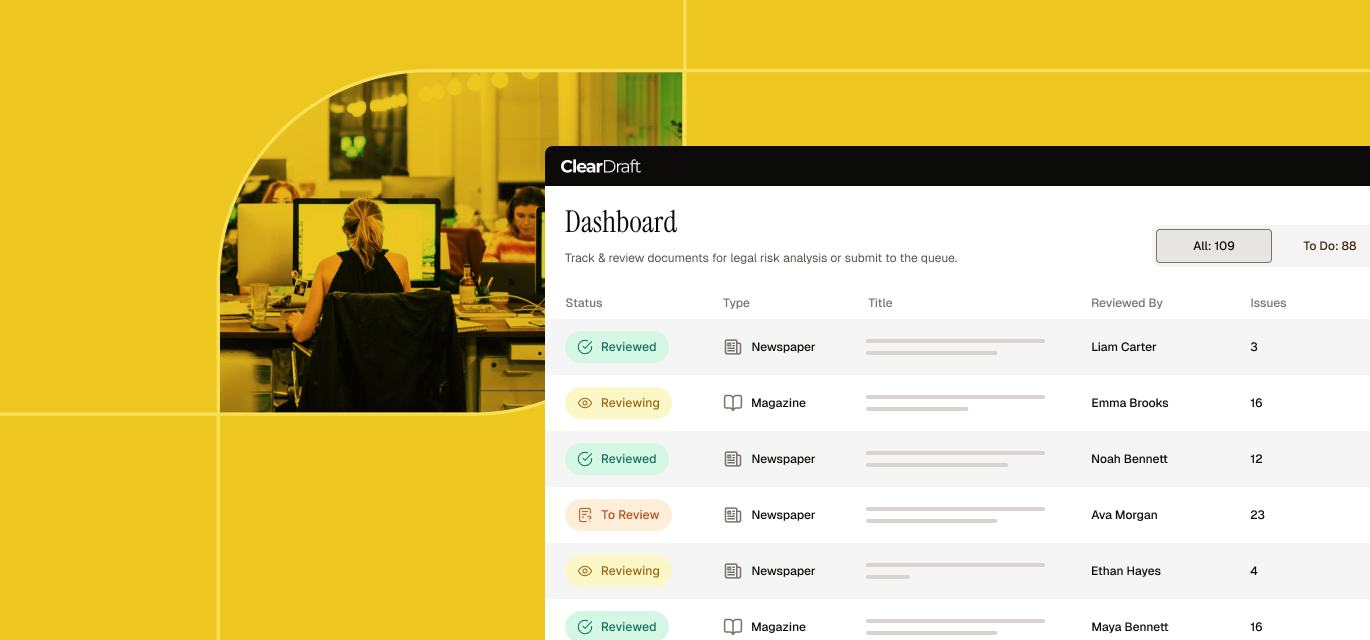
Once a story has been drafted, it is submitted to ClearDraft for rapid screening. The system flags potential legal risks, provides context behind each issue, and pinpoints possible defenses - providing teams with a clear sense of which pieces require deeper scrutiny and which can move forward with minimal intervention.
2. Targeted Legal Assessment
With potential risks highlighted quickly and earlier, legal teams can concentrate on the areas that warrant careful analysis. Rather than working through entire drafts line by line, they are able to focus on higher-risk passages - enabling more substantive input on complex or sensitive stories, while reducing time spent on routine material.
3. Fewer Disruptions at the Point of Publication
Following review, journalists revise their work based on the provided legal annotations. Because risks have been identified and addressed earlier in the process, stories move forward with fewer delays and reduced need for last-minute intervention.
The result is a more deliberate approach to legal review. In high-volume environments, routine material can move efficiently, while more complex stories receive the depth of analysis they require.
See how this works in practice
If you're looking to streamline your newsroom’s clearance process, our guide, Beyond the Legal Bottleneck: How ClearDraft Helps Newsrooms Prioritize High-Impact Stories and Publish with Confidence, explores how you can introduce structured risk triage into your workflow.
Download the guide to see how leading teams are rethinking legal review
A More Scalable Model for Newsroom Legal Review
As newsroom output continues to scale, the gap between publishing speed and traditional clearance processes will only widen. Without structural change, the legal review process risks becoming a bottleneck that slows publication, stretches resources, and limits focus on the stories that matter most.
By introducing structured risk visibility earlier in the process, ClearDraft enables legal review to operate more effectively at scale. As publishing volume continues to grow, this shift allows newsrooms to maintain high standards without slowing output - bringing legal review into alignment with the pace and demands of modern publishing.
ClearDraft is now available for news organizations looking to modernize their content clearance workflow.
If you’d like to learn more about how the platform fits into your existing editorial and legal processes, reach out to our team for a demo - or download our guide Beyond the Legal Bottleneck: How ClearDraft Helps Newsrooms Prioritize High-Impact Stories and Publish with Confidence