We’re excited to announce the launch of ClearDraft, the AI-powered media law platform designed to help modern newsrooms manage one of the industry’s fastest-growing operational challenges: the content clearance bottleneck.
In an era of round-the-clock digital publishing, newsrooms operate under constant pressure to produce and publish at speed. Stories move rapidly across platforms, and the demand for real-time updates means more content than ever is entering editorial pipelines each day.
At the same time, the systems responsible for reviewing that content have failed to evolve at the same pace. Financial pressures across the media industry have led to smaller editorial and legal teams, while many clearance workflows were designed for a far slower publishing cycle.
The result is a growing strain on newsroom legal review: large volumes of material enter clearance each day while legal capacity remains limited. Backlogs build, last-minute escalations become common, and teams operate under constant deadline pressure.
ClearDraft was created to help address this strain. By surfacing potential legal risks earlier in the editorial process, the platform gives newsrooms clearer visibility into draft articles before they reach formal review - allowing legal teams to focus their expertise where it matters most: intensive legal review, investigative reporting and high-risk stories.
Rethinking Legal Review for Modern Publishing
ClearDraft was built on a simple core idea: the systems that protect responsible journalism must evolve to keep pace with the speed and scale of modern publishing.
For media lawyers Alex Wade and David Burgess, that insight was shaped by six decades of combined media law experience. Over the course of their careers, they saw firsthand how the legal processes supporting publication were struggling to keep up with the pace and volume of today’s newsrooms.
Content clearance workflows in particular had become an increasing source of friction. Originally designed to safeguard responsible publishing, these processes had increasingly turned into slow and costly bottlenecks - delaying stories and, in some cases, preventing them from reaching readers altogether.
Determined to find a better way, Wade and Burgess set out to rethink how content clearance could work in a modern newsroom. The result was ClearDraft: a platform that combines AI-driven media law analysis with expert human review to surface potential legal risks earlier in the editorial workflow - helping stories move through clearance more efficiently while preserving rigorous legal oversight.
While ClearDraft initially addresses the needs of modern newsrooms, its broader goal is to make content clearance faster, more scalable, and more widely accessible across the entire publishing ecosystem.
To support this vision, ClearDraft aims to expand its content clearance tools across the wider publishing ecosystem, including television and film, book publishing, and other forms of digital media.
Equally important is our commitment to empowering independent creators who have historically had little or no access to legal support. By democratizing access to media law expertise, ClearDraft will enable authors, journalists, and digital creators to navigate complex rights issues with greater clarity and confidence.
Ultimately, the platform is grounded in a core principle: a free press depends not only on the ability to pursue bold stories and investigative reporting, but also on the legal frameworks that allow that reporting to be published with confidence. By strengthening those frameworks for the modern era and reducing review costs, ClearDraft seeks to help news organizations pursue rigorous, impactful journalism while managing legal risk responsibly.

The Content Clearance Bottleneck
In many news organizations, every story entering the editorial pipeline follows essentially the same path into legal review. Whether the material involves routine coverage, breaking news, or complex investigative reporting, it often arrives in the same clearance queue with little visibility into the level of legal risk it may actually present.
This bottleneck exists because the traditional clearance process combines two distinct tasks:
- Detecting potential legal risk
- Determining how that risk should be addressed.
Because these steps occur within the same workflow, legal teams must perform both tasks simultaneously for every piece of content.
ClearDraft was designed to separate these two stages.
By analyzing draft articles early in the editorial process, ClearDraft surfaces language patterns and contextual signals associated with potential legal exposure - including defamation, privacy concerns, contempt of court issues, and other media law risks.
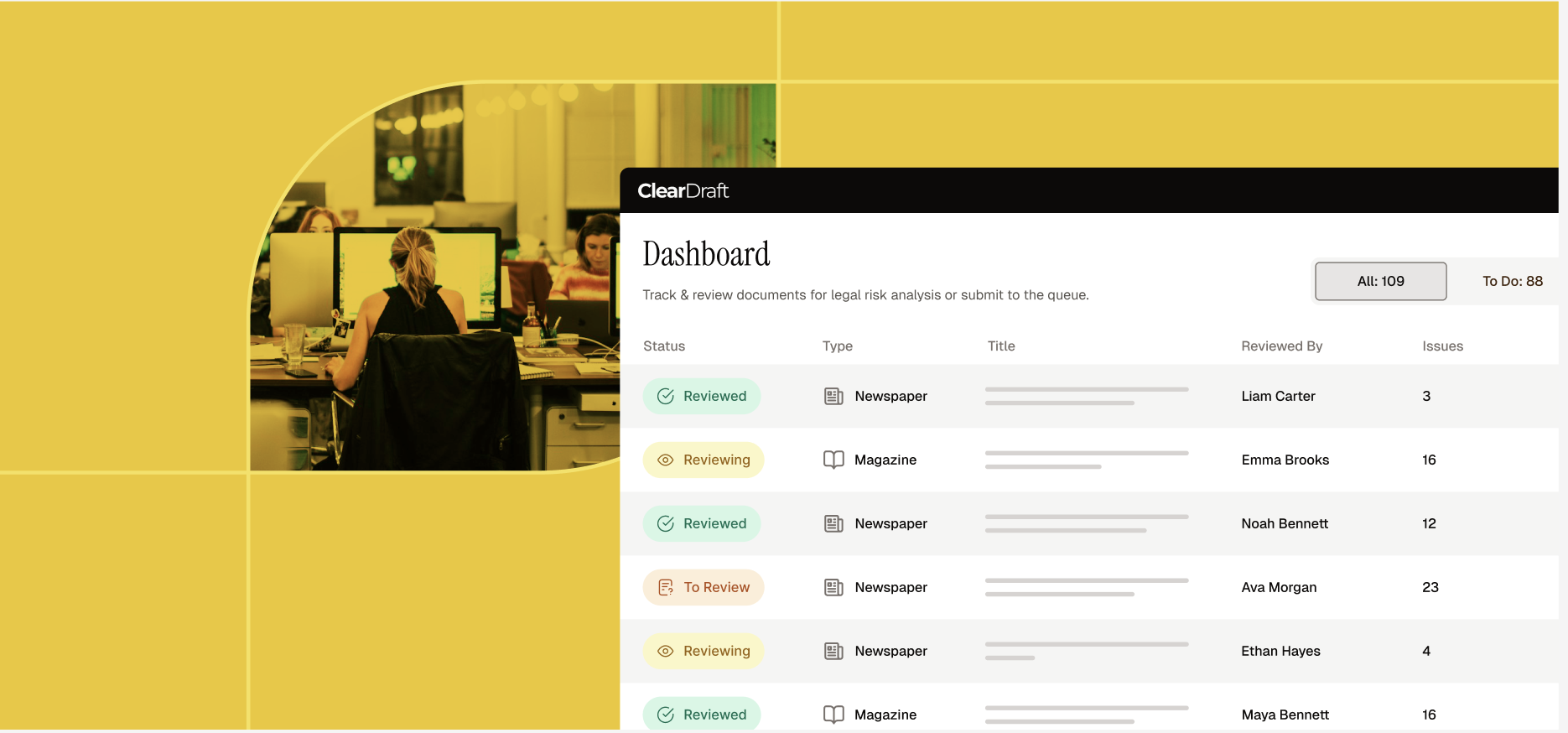
In a typical newsroom scenario, an article containing allegations about a named individual may trigger ClearDraft to flag the passage, highlight language patterns commonly associated with defamation exposure, and provide an explanation of why the content may warrant closer review. ClearDraft will also identify applicable defences. Editors and legal teams can immediately see where additional legal scrutiny may be needed.
This early visibility allows routine coverage to move efficiently through the pipeline while drawing attention to stories that are more likely to require careful legal review.
The result is a clearance process that allows legal teams to focus their expertise where it matters most: providing thoughtful guidance on the reporting that genuinely demands careful scrutiny.

What ClearDraft Makes Possible
By introducing early visibility into potential legal risk, ClearDraft helps newsrooms:
- Focus legal review on stories most likely to carry legal risk
- Reduce time spent manually scanning routine reporting
- Identify sensitive claims earlier in the editorial process
- Avoid last-minute legal escalations before publication
- The result is a content clearance process that is more predictable, more efficient, and better aligned with the speed of modern publishing.

How ClearDraft Works Inside the Newsroom
ClearDraft is designed to integrate into newsroom operations without disrupting existing editorial or legal processes. It does not replace approval pathways, alter reporting standards, or shift editorial authority. Instead, it introduces early visibility into potential legal risk within draft articles before formal legal review begins.
In practice, the workflow unfolds in three stages.
- Early Draft Analysis
A journalist submits a draft of their story to ClearDraft. The platform’s AI analyzes the text to identify language patterns associated with potential media law risks. Potentially sensitive passages are flagged directly within the article, allowing the draft to move quickly into legal review.
- Focused Legal Review
The annotated draft moves to human legal review, where counsel - either ClearDraft lawyers or in-house legal teams - evaluates the flagged passages in context and provides legal guidance or recommended revisions directly within the document.
It is important to note, ClearDraft AI does not make legal determinations or replace legal judgment. Instead, it surfaces potentially sensitive passages and brings them to the attention of counsel, who can then apply their professional expertise.
- Revision and Publication
The journalist receives the annotated version of their story. Based on the advice provided, they can now revise flagged passages and move toward publication with fewer last-minute legal escalations.
Want to learn more? Download our guide, Beyond the Legal Bottleneck: How ClearDraft Helps Newsrooms Prioritize High-Impact Stories and Publish with Confidence, to explore how modern newsrooms are rethinking content clearance.
The Future of Content Clearance
Responsible journalism has always relied on careful legal review to protect reporters, publishers, and the public. But as the scale and speed of digital publishing continue to grow, the systems that support that work must evolve as well.
ClearDraft was built to help news organizations meet that challenge. By introducing early visibility into potential legal risk, the platform allows editorial and legal teams to prioritize their attention more effectively - ensuring that careful legal judgment can be applied where it matters most.
The goal is not to replace the safeguards that responsible reporting depends on, but to help those safeguards operate more effectively within the realities of modern publishing.
ClearDraft is now available for news organizations looking to modernize their content clearance workflows. If you’re interested in seeing how ClearDraft works inside a newsroom environment, please reach out to our team for a demo.